
Two days after US-Israeli strikes killed Iran’s supreme leader Ali Khamenei, the governments surrounding the Persian Gulf have said little publicly. The silence is not a coincidence. Data measuring political freedom across the region shows why.
Six of the eight countries bordering or near the Persian Gulf are rated “closed autocracies”, the lowest possible classification by the world’s most cited democracy research project. The remaining two, Iraq and Iran, score only marginally higher. None of the eight qualifies as a democracy.
What numbers say
The Varieties of Democracy Institute, or V-Dem, a Swedish academic consortium that has tracked political freedom in 179 countries since 2000, scores each nation on a Polyarchy Index from 0 to 1, where 0 is fully autocratic, and 1 is fully democratic.
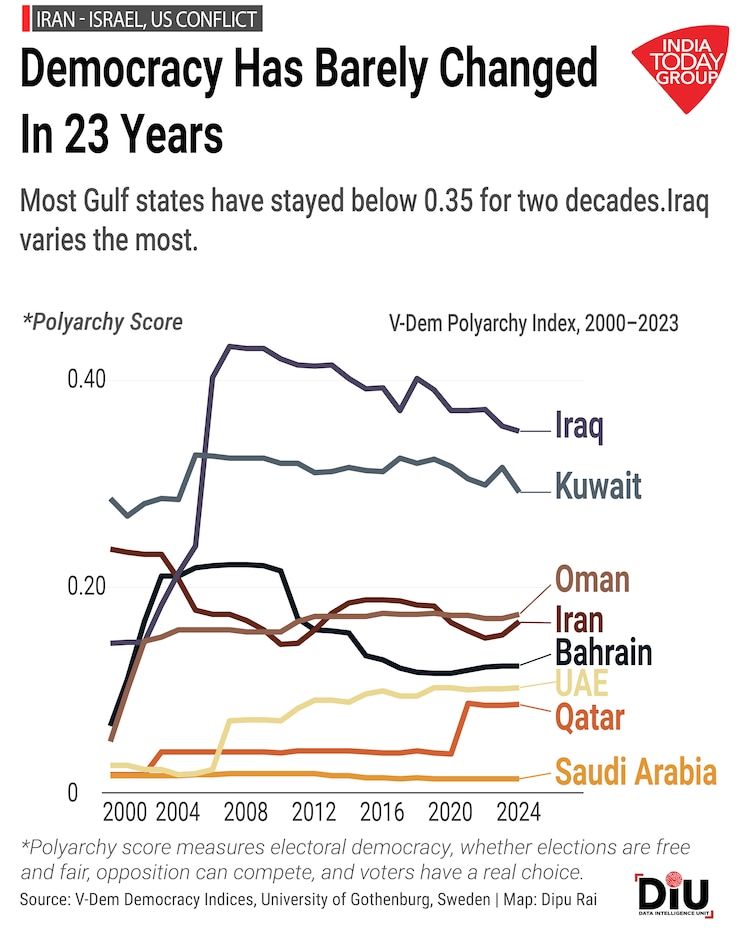
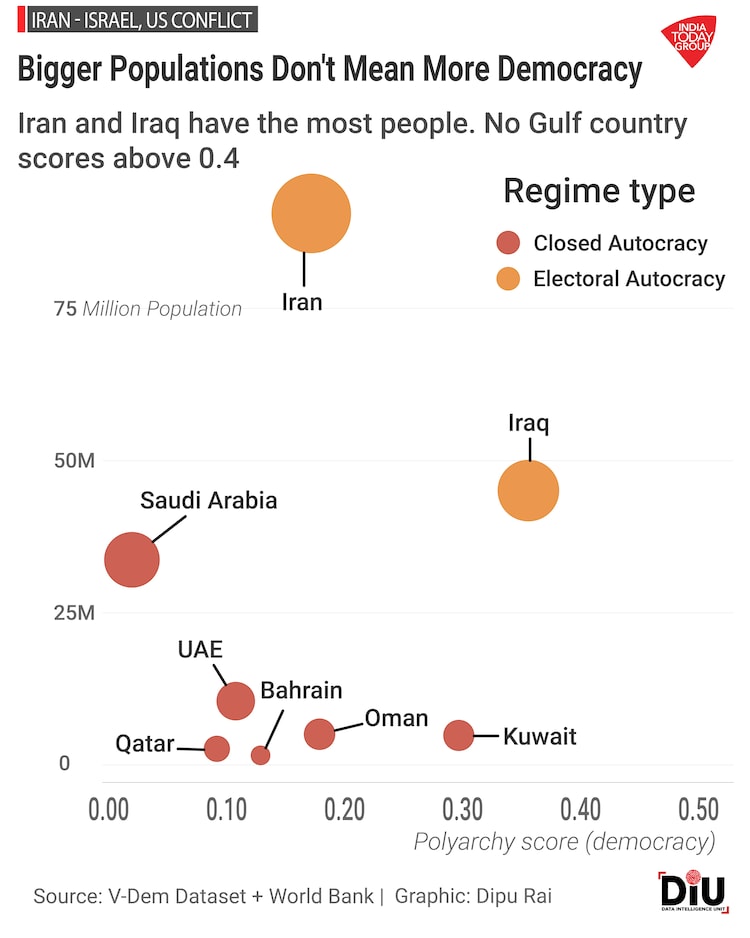
In 2024, Saudi Arabia scored 0.02, the lowest in the region and among the lowest on earth. Qatar scored 0.09. The United Arab Emirates managed only 0.10. And Bahrain, 0.12. Iraq, with the highest score at 0.35, and Iran, with 0.17, sat in V-Dem’s “electoral autocracy” category — both hold elections, but neither holds them fairly.
The scores have barely moved in 23 years. Since 2000, no Gulf state has crossed 0.40 on the index. Most have flatlined.
Monarchies, not democracies
Five of the eight countries are monarchies. Three — Saudi Arabia, Qatar, and Oman — are absolute monarchies where the ruling family holds legislative, executive, and judicial authority without electoral checks.
Kuwait and Bahrain have constitutions and elected chambers, but neither has a parliament that can remove the government. Kuwait dissolved its elected National Assembly in 2024. Bahrain’s elected chamber can question individual ministers but cannot remove the prime minister.
The UAE is a federation of seven hereditary emirates. Its advisory Federal National Council is half-appointed, half-elected through a restricted electoral college with no binding authority.
None of these bodies can pass laws without royal or emiral assent.
“None of the leaders (with the partial exception of Kuwait) has to face an elected parliament with real powers, or a free press,” Gregory Gause, a political scientist, wrote in a 2015 assessment that remains accurate more than a decade later.
Iran: elections without democracy
Iran is different from its Gulf neighbours, and the difference matters: Iran holds regular elections for the presidency and parliament. V-Dem classifies it as an “electoral autocracy”, the same category as Iraq, because those elections are real enough to count, but not free enough to matter.
The Supreme Leader controlled who appeared on the ballot, which laws survived, and which protests were crushed. After mass disqualifications of candidates in 2021, V-Dem briefly reclassified Iran as a “closed autocracy”. A snap presidential election in 2024, called after President Raisi died in a helicopter crash, allowed more candidates to run, and V-Dem moved Iran back to its previous classification.
Khamenei’s death removes the architect of that system. It does not remove the system. The Assembly of Experts — all clerics, none elected by open ballot — selects the next supreme leader.
The Islamic Revolutionary Guard Corps controls an estimated 40 per cent of Iran’s economy and operates independently of civilian ministries.
Neither institution has an exit mechanism for outside voices.
Iran’s civil liberties score is 0.26 out of 1. Its freedom of expression score is 0.23. Both are lower than Iraq, Kuwait, and Oman. Saudi Arabia is the only country in the study that scores lower on civil liberties.
The wealth-democracy gap
The Gulf states, undemocratic as they are, rank among the richest countries on Earth. Qatar’s GDP per capita is $81,817, one of the highest in the world. Its Polyarchy score is 0.09. The UAE’s GDP per capita is $49,851. Its score: 0.10. Saudi Arabia sits at $36,157 per capita and 0.02 on the democracy index.
Iraq, the region’s only country with a functioning elected parliament, has a GDP per capita of $5,965, a fraction of its Gulf neighbours. Iran, at $5,049, is the poorest country in the study.
Wealth and democracy seem to have an inverse correlation in the Gulf.
The religion factor
All eight countries are majority Muslim, ranging from 68 per cent in Qatar to 99 per cent in Iran. The branch of Islam — Sunni, Shia, or Oman’s Ibadi tradition — shapes fault lines that the current conflict has widened.
Iran’s Shia theocracy has for decades funded Shia militias in Iraq, Lebanon, and Yemen. Saudi Arabia’s Sunni monarchy has countered that influence across the region. Bahrain, where a Sunni monarchy governs a population that is roughly half Shia, is watching this week’s events with the closest attention.
Qatar and the UAE host large expatriate workforces. Non-Muslims make up nearly a third of the population in both countries. Those workers have no political rights and no path to citizenship.
Iraq’s position is the most difficult. With a Polyarchy score of 0.35, it has the region’s most open political system. A functioning, if fragile, elected parliament. It also hosts both US troops and Iranian-aligned militias on the same soil. Its government has called for de-escalation without naming a side.
Digital participation as substitute
Gulf governments are not ignoring demands for political participation. They are redirecting them.
Saudi Arabia’s Tafaul digital platform logged 72.8 million users and 133 million visits as of January 2025, covering public comment on education, health, labour, and environmental policy. Qatar’s Sharek platform allows citizens to discuss and rate education policy proposals.
Citizens can comment on these platforms. They cannot vote, and comments carry no binding authority.
In November 2024, Qatar held a referendum that replaced elections for 30 of its 45 Shura Council seats with full appointment by the Emir. Elected participation was reduced, not expanded.
What the strikes change and what they don’t
The February 28 strikes were planned and executed from the same regional architecture that Gulf governments quietly enable. Qatar hosts the forward headquarters of the US Central Command. Bahrain is home to the US Navy’s Fifth Fleet. The UAE and Saudi Arabia granted overflight rights and logistics access, making coordinated strikes on Iran possible.
None of these governments has commented publicly on the strikes. Their silence reflects the same calculation that has defined Gulf foreign policy for decades: security dependence on Washington, DC, economic dependence on stable oil markets, and political pragmatism of not provoking their own populations.
Political scientists call this the “authoritarian bargain”: governments provide economic security and social order, and populations accept the absence of political rights. It has held across Saudi Arabia, the UAE, Qatar, Oman, and Bahrain for generations.
Whether Khamenei’s death and Iran’s political transition will test that bargain in the Gulf’s Shia communities, particularly in Bahrain and eastern Saudi Arabia, is the question this region’s rulers are asking in private this week.
Note: The Polyarchy Index measures free and fair elections, freedom of expression, civil society participation, and freedom of association on a 0-to-1 scale. The Civil Liberties and Freedom of Expression indices follow the same scale. V-Dem scores are from 2024, the most recent year available.
Religion figures are courtesy of the Pew Research Centre’s Global Religious Landscape study, supplemented by national census data.
Yemen is excluded from this analysis. It meets the geographic definition of a Gulf state, but the ongoing civil war makes a single classification unreliable. Turkey is excluded; it borders the region but is not a Gulf state.
– Ends


