
Tamil Nadu is the graveyard of national political parties. It buried the Congress at its peak then in 1967. The BJP, also at its peak now, has been pregnant with possibilities but has failed to deliver. Never a serious player in the state before the dawn of the Modi-era, the BJP has been humbled in every election since his arrival in 2014 (2019, 2021 and 2024).
Pundits and laypersons, Tamil Nadu confounds everybody alike. What makes it the strongest citadel of regionalism in contemporary politics that is now soaked in nationalism? Why is it a unique entity even among its culturally similar southern states? All these states are also fiercely proud of their cultural moorings, but none practices antagonism to national parties as a principle of state policy, so to say. What makes it stand out and stand apart? Is it true that a monolithic national narrative suppresses or seeks to suppress the state’s distinct Tamilakam (Tamil Nadu of yore) identity and ancient glory? Or, do the state’s Dravidian parties deliberately stoke the sense of cultivated alienation and grievance to perpetuate their careers? What has Dravidian politics delivered that the state does not want a taste of any other model? What is the collective angst of the Tamils? Is it justified? Why can’t the rest of India fathom it? As another grand electoral spectacle looms in 2026, these are some of the myriad questions that need to be addressed. Not to predict winners and losers, but just to understand why Tamil Nadu is the way it is.
In this new series, that is what Chennai-based senior journalist, TR Jawahar, will attempt to do. He will dig deep into history and heritage, arts and archaeology, language and literature, cinema and culture, kingdoms and conquests, castes and communities, religion and race and, of course, politics and pelf, to paint a picture of the state that might help you understand whatever happens when it happens.
Read More
In Chennai’s Anna Nagar, a bustling suburb named for the statesman who scripted the Dravidian dawn, the arch stands as a poignant portal to his arc – a concrete nod to the orator who turned Periyar’s thunder into tangible triumphs. In the Tamilian psyche, Anna Nagar is the living postal code of a revolution. This is where the man became the message, bridging radical roots to realistic reign, his life a lens for TN’s tangled political tapestry.
Scholarly Seeds
Conjeevaram Natarajan Annadurai – Anna to the masses – entered the
world on September 15, 1909 in Kanchipuram, the legendary “City of a
Thousand Temples.” He was born into a modest weaver family from the
Sengunthar Mudaliar community, an environment where the rhythmic, hypnotic
clatter of the handloom provided the background score to a life of early
intellectual curiosity. The loom itself was a profound metaphor for his later
life: Perfecting the art of weaving disparate, often contradictory threads of
thought into a singular, durable fabric of social justice.
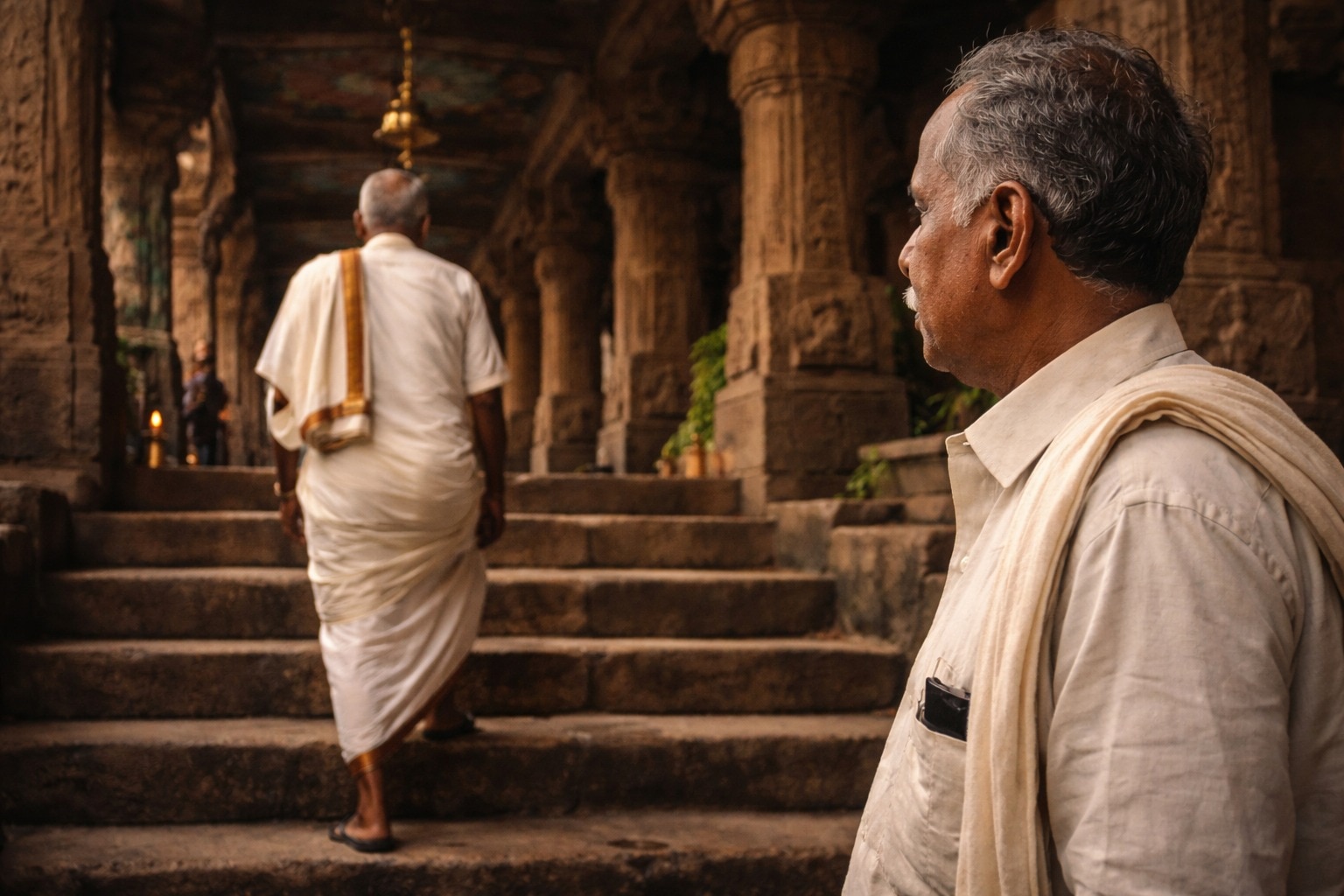
An AI-generated image shows C.N. Annadurai observing his father as he climbs the steps of a temple in Tamil Nadu in the 1970s.
His father, Natarajan, was a temple priest and small trader, while his
mother, Bangaru Ammal, managed a household that, while economically lean, was
spiritually and culturally vibrant. Growing up in a home steeped in classical
Tamil literature and the sonorous traditions of Vaishnava devotion, young Anna
was the middle child in an atmosphere that demanded both tradition and a
burgeoning awareness of the winds of change sweeping through the Madras
Presidency.
Kanchipuram was then a crucible of Vedic tradition and a stronghold of
the Brahminical elite, but the young scholar was already looking toward a
different kind of enlightenment—one that didn’t require a sacred thread but a
sharp, analytical mind. His early years were a “Scholastic Spring,”
where the handlooms of his community taught him the essential patience required
to construct a grand narrative, thread by meticulous thread. He realized early
that a society, like a saree, is only as strong as its weakest fibre.
Oxford of the Orient
His school days at Pachaiyappa’s High School shone with an early,
unmistakable promise that marked him as a “Polyglot Powerhouse” in
the making. While his peers were content with the dry, rote-learning typical of
the British colonial curriculum, Anna was diving headlong into the Global Gloss
of English literature. He excelled in both, The Queen’s Tongue and mother
tongue Tamil, with a dexterity that baffled his instructors, moving between the
classical Sangam verses and Western political views with seamless grace.
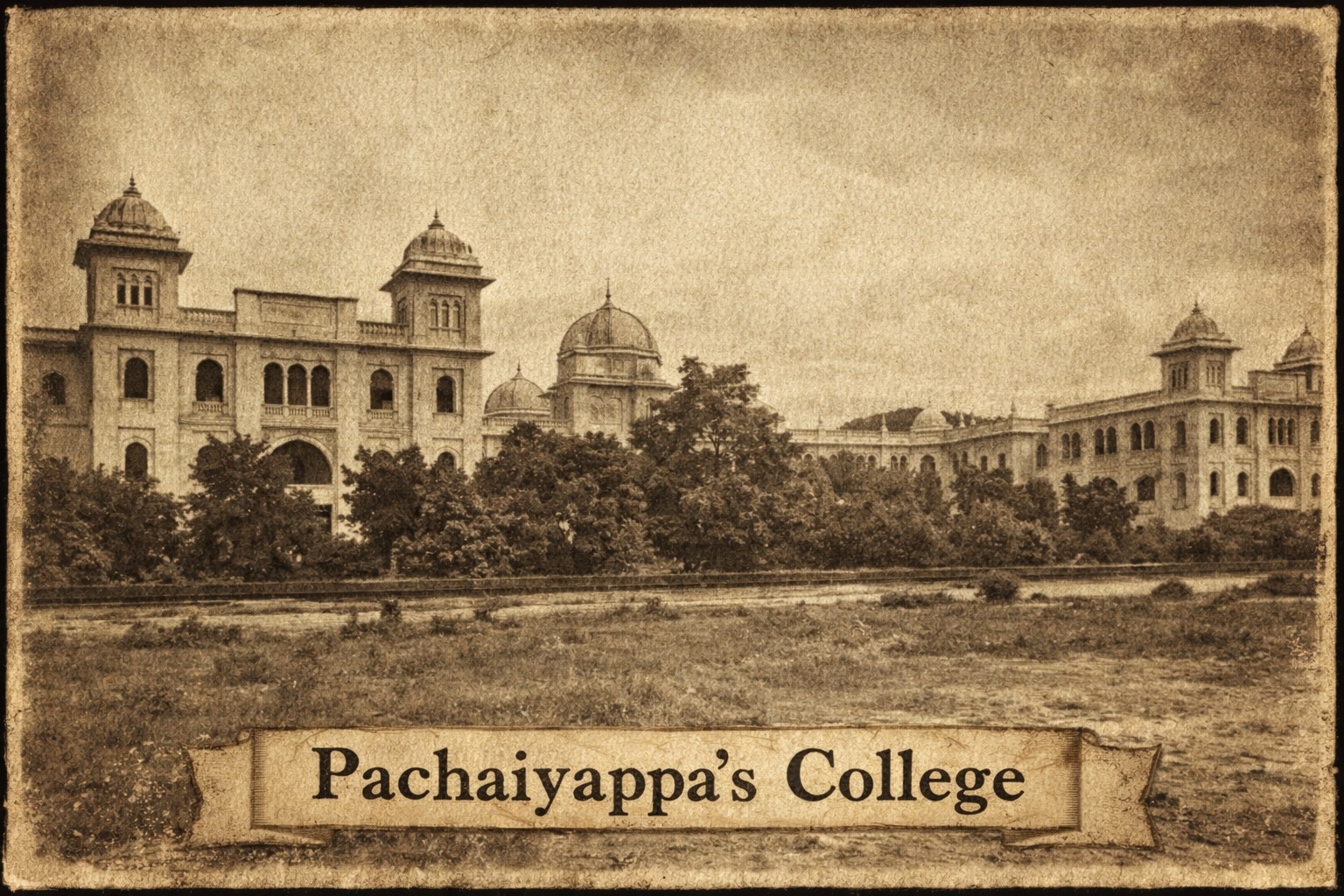
Anna studied at the prestigious Pachaiyappa’s College.
This scholarship eventually earned him a BA from the prestigious
Pachaiyappa’s College in 1930, followed by an MA in Economics and Politics.
During his college years, he was known as the “Library Lion,” often
found buried in texts that spanned the spectrum of Western liberal democracy
and Eastern classical lore.
Anna’s English proficiency was not a happy accident; it was a
deliberate and calculated linguistic linkage. He realized that to challenge the
“Aryan Monopoly” and the colonial masters simultaneously, one had to
wield the colonial tongue with a Parliamentary Polish that exceeded even the
colonizers themselves. He drew his inspiration from an avid, almost obsessive
reading of George Bernard Shaw and Charles Dickens.
From Shaw, he inherited the sharp, paradoxical wit and the ability to
mock social absurdities with a straight, scholarly face; he saw in Shaw’s
“Superman” a parallel to the Dravidian hero. From Dickens, he learned
the art of social drama and the power of the “common man’s cries,”
realizing that the struggle of the London poor was mirrored in the plight of
the Tamil weaver. The poverty of the platform reached out to his discerning
heart and head. ‘I see God in the smile of the poor’, he would later proclaim.
“Literature is the lamp of life,” he would frequently say—a
coinage that lit his early path through the literary archives of Madras. He
traded the bazaar for the library, realizing that the pen was not just mightier
than the sword, but more surgical than the sledgehammer. He was the
“Oxford of the Orient” in a simple dhoti, a man whose mind processed
ancient Tamil roots and modern economic syntax with a dazzling, alliterative
finesse. He was crafting a new kind of rhetoric—one that used puns, punches, and
flowery phrases to bridge the gap between the university and the street corner,
turning the Tamil tongue into a political tide.
Stage Spark & Celluloid Canon
Anna’s entry into the world of stage and cinema in his late 20s was a
“Qualitative Shift” that ignited a trend continuing to steer the
Tamil Nadu political engine today: the use of cultural expression as an
unswerving political, social, and propaganda weapon. He realized that in a land
where the printing press touched only the literate few, the “Silver
Screen” and the theatre stage could reach the millions who gathered under
the night sky for a performance. He was the “Scripted Statesman” who
turned the stage into a “People’s Pedestal,” realizing that a
well-delivered discourse was more effective than a dozen pamphlets.
Joining the stage in his 20s, he penned plays like Velaikkari (1949),
which was not just a theatrical blockbuster, but a “Cinematic
Cannonball” aimed at the hull of the feudal order. The play skewered caste
hierarchy, religious hypocrisy, and the hollow superstitions of the elite
through dialogues that doubled as DMK Doctrine. “Cinema is the common
man’s university,” Anna quipped, and he meant it literally. He used the
screen to perform a purge on the superstitious mindset that had kept the masses
in a state of “Gilded Servitude.” He transformed the
“Entertainment Hour” into an “Enlightenment Session” with
every movie hall turning into a Rationalist Lecture Room.
With M. Karunanidhi as his apprentice scribe—the young
“Kalaignar” honing his pen under Anna’s vigilant, scholarly eye—they
crafted narratives that rallied crowds across the peninsula. Ore Iravu (1951)
was another masterstroke, a “One Night” drama that blended romance
with radical reform in a way that made the “Rising Sun” seem like a
natural dawn. It was a time when the “Alliteration Architect” was
training his “Thambis”, Brothers, to turn words into weapons and
scenes into social manifestos.
M.G. Ramachandran (MGR), starred in many of these early, essentially
propaganda productions that easily passed for popular cinema, his infallible
hero-image—the “Makkal Thilagam”—mirroring the leadership aura the
movement required. Anna understood the “Sway of the Star” long before
political scientists coined the term. “Film is the folk’s forum.”
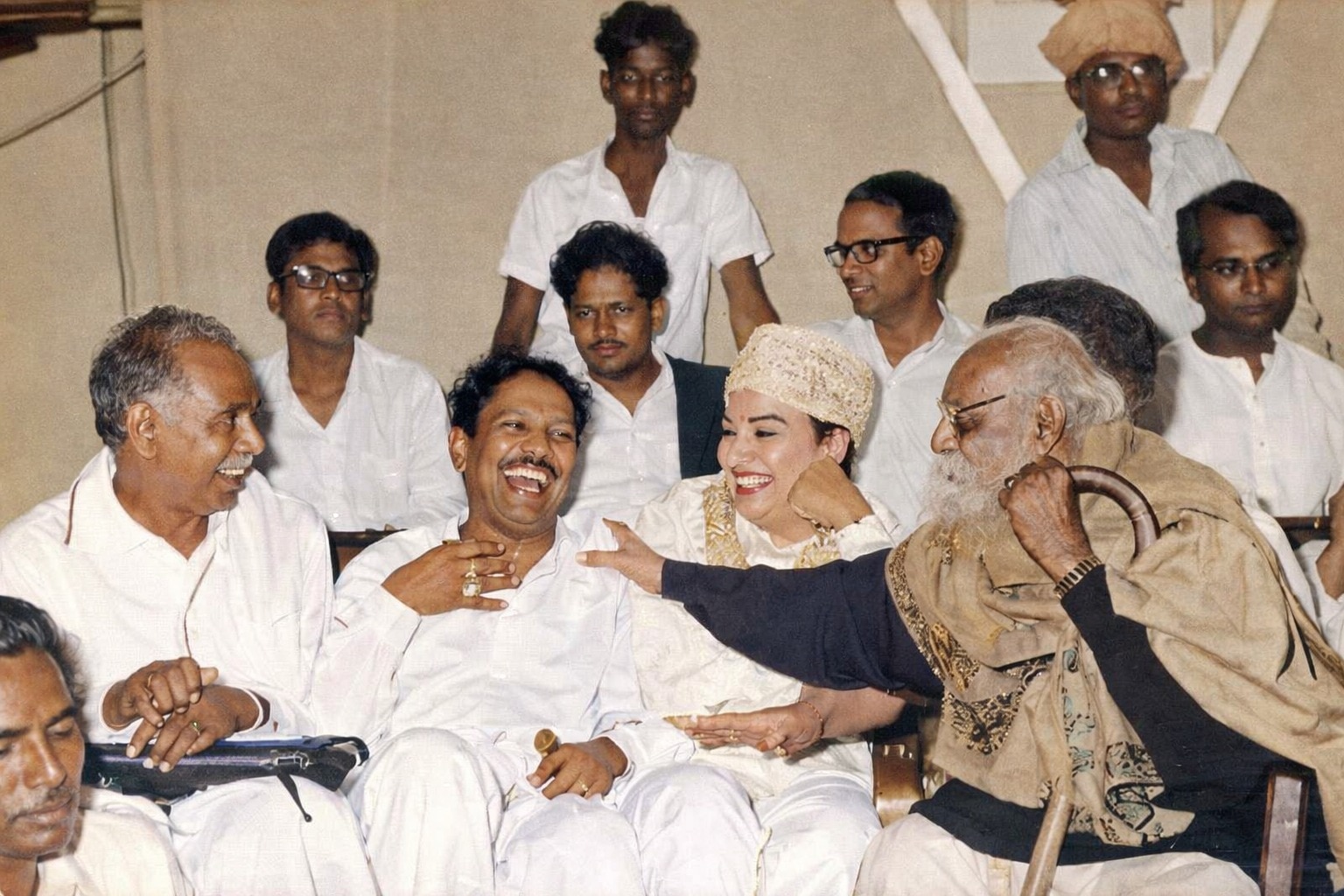
Annadurai, Kalaignar, Periyar, and M.G. Ramachandran captured together – a powerful frame of Tamil Nadu’s most influential leaders.
Even the great poet Kannadasan was part of this creative crucible, his
lines adding a lyrical lilt to the rationalist roar. This wasn’t just
entertainment; it was “Electoral Elixir,” a vehicle that bridged the
gap between the intellectual elite and the rural heartland. Sampath, Periyar’s
nephew, the firebrand orator, acted in some of these productions too, his fiery
delivery amplifying the messages of social equality. In all, Anna turned the
“Screen Idol” into a “Statute Book Icon,” ensuring that the
“Makeup” of the matinee idols was backed by the “Mandate”
of the movement.
Discipleship Dawn
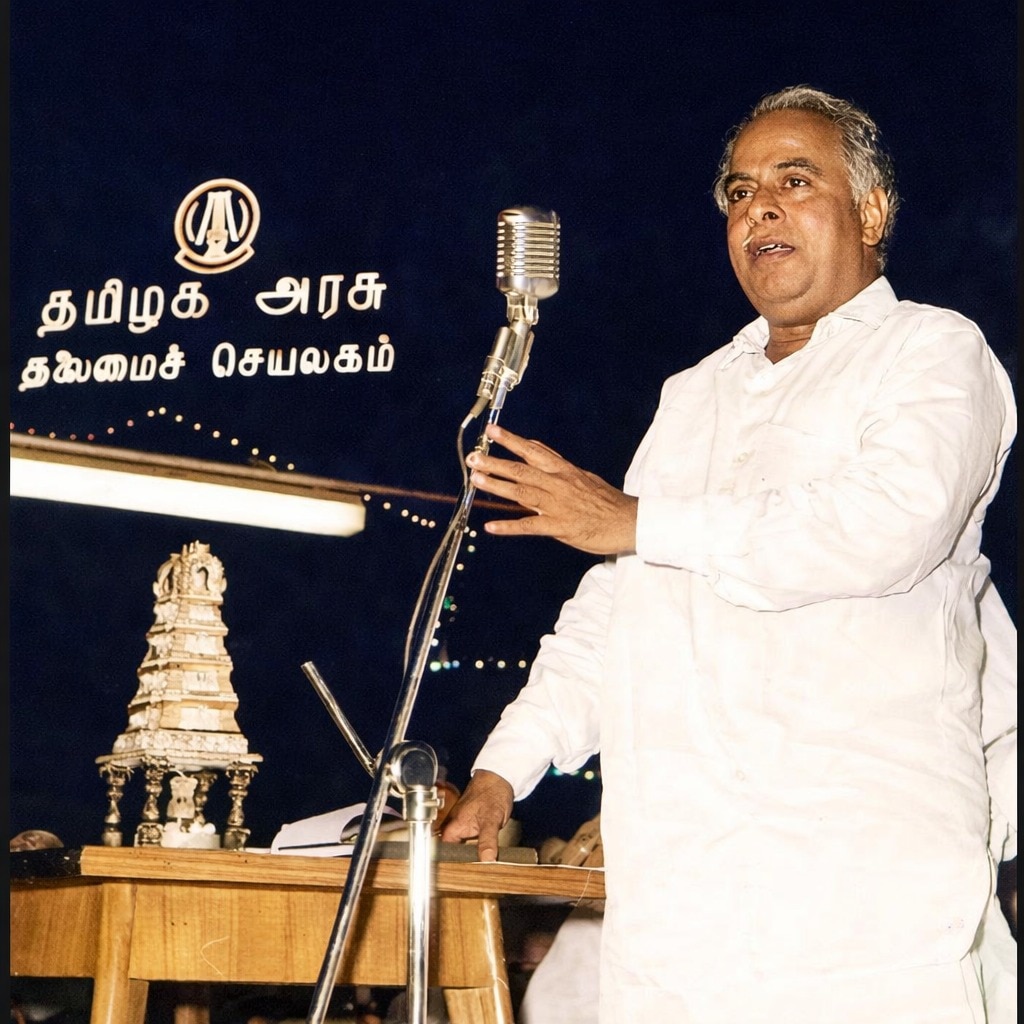
Anna’s political plunge came under the influence of the “Bearded Oracle” of Erode, Periyar.
Anna’s political plunge came through the “Bearded Oracle” of
Erode. He joined the Justice Party (later DK) in 1935 as a disciple drawn to
Periyar’s anti-caste fire and uncompromising rationalism. “Periyar is the
prophet of self-respect,” Anna declared in his early editorials, absorbing
the master’s hard logic but fine tuning its serrated edges with his own
scholarly touch.
He was the Pragmatic Protégé who understood that while the
“Thunder” of Erode was necessary to break the silence of centuries,
it needed a “Softer Symphony” to build a sustainable political
consensus in a diverse democracy. He was the “Diplomat of the
Dravidian” who knew when to roar and when to reason.
As Periyar’s protege, he rose with the velocity of a comet in the
Dravidian firmament. He edited Kudi Arasu, delivering speeches that blended
Periyar’s roar with his own alliterative eloquence. At the historic 1944 Salem
Conference, it was Anna who provided the technocratic template for rebranding
the Justice Party as the Dravidar Kazhagam (DK), stripping away colonial titles
like “Diwan Bahadur” and “Rao Bahadur” to make way for a
black-shirted revolution of the masses. He learned the “Cadre
Command”—how to identify issues in government files, how to stir a crowd
without losing the nuances of scholarly logic, and how to spot the “Caste
in the Code.”
Young Anna cherished and nourished His Master’s Voice. “Guru’s
word is gospel,” he would say, inspiring a similar, absolute loyalty from
his own juniors. Yet the seeds of a shift were present from the start with the
fresher’s footprint not often falling in line with the Father’s imprint. Anna’s
inclusive “Tamilism” began to clash with Periyar’s more exclusive,
radical categories.
He was moving toward a practical politics that prioritized the ballot
over the boycott, the assembly over the agitation. He was the “Scholar in
the Storm” who was already eyeing the “Parliamentary Pathway,”
realizing that for the Dravidian movement to survive in a post-freedom India,
it needed to move from the picket line to the polls. He became the
“Lighthouse of the Loyalty,” showing his Thambis that knowledge was
the only armour that could withstand the heat of the Nationalist Forge.
Rift, Rupture & Rise
The 1949 Maniammai marriage was the rupture that redefined the
Dravidian arc forever. To Periyar, it was an absolute imperative to ensure
party continuity and asset protection; to Anna, it was an “Ego
Explosion”, a personal pettiness that threatened ideological integrity,
and a betrayal of the democratic pretences of a “Self-Respect”
movement. “This is not self-respect, but self-interest,” Anna implied
in his emotional speeches, his departure earning Periyar’s famous and derisive
“Kanneer Thuligal” (teardrops) jab. But those tear-drops helped the
seeds of a new storm to sprout. He felt that the master had prioritized
personal legacy over the movement’s moral high ground.
The break culminated in the pouring rain at Robinson Park on 17 September
1949. As the sky wept in a “Dravidian Deluge,” Anna delivered his
famous “Teardrop” Farewell. He didn’t just walk away; he performed a
“Soulful Soliloquy” of grief that earned him the absolute loyalty of
the youth who were tired of the “Oracle’s Autocracy.” He birthed the
DMK (Dravida Munnetra Kazhagam) that night, a party that would take the
“Rationalist Reality” and dress it in the “Cinematic Charm”
and “Parliamentary Polish” required for electoral victory. He traded
the “Black Shirt” for the “Rising Sun.”
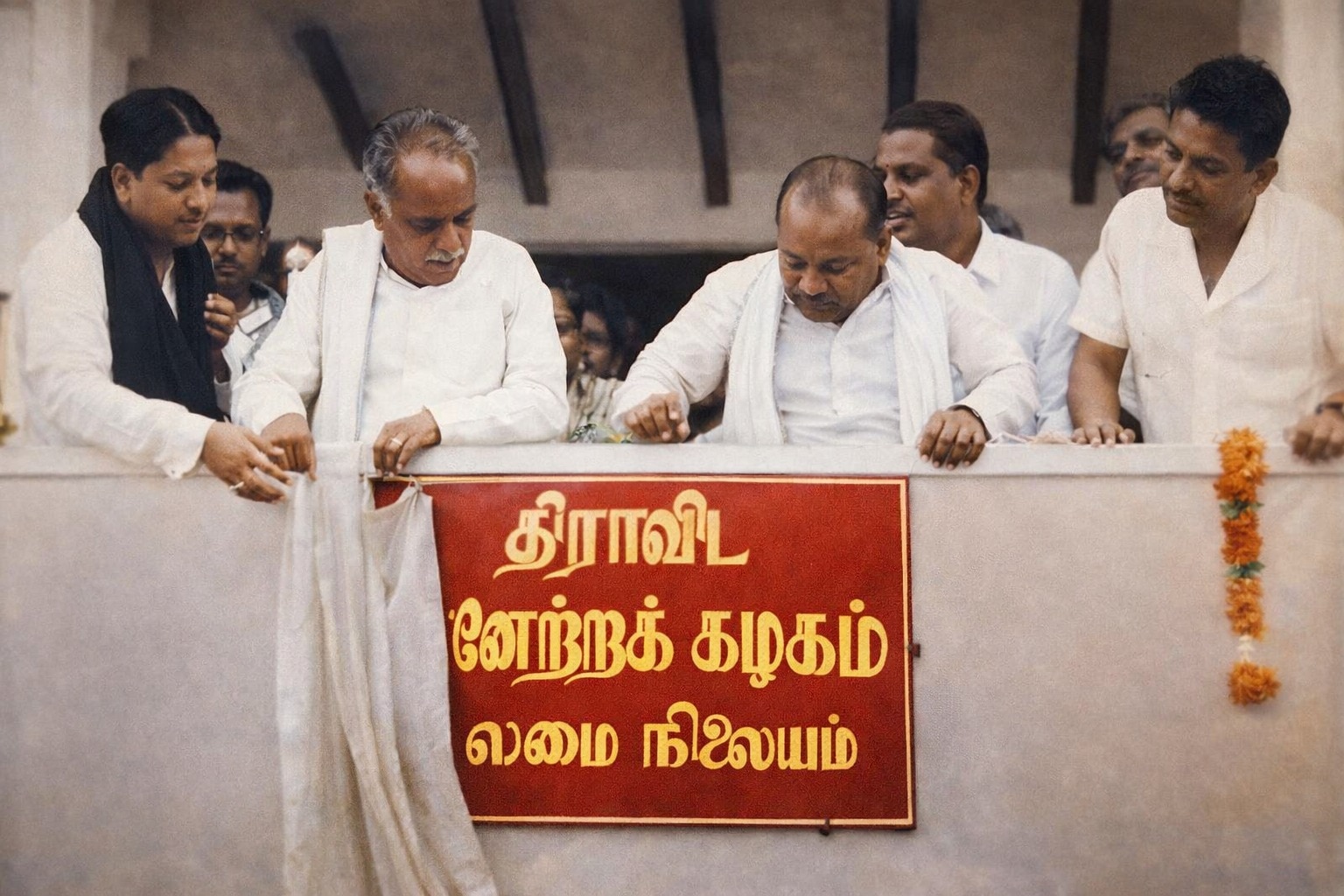
C.N. Annadurai founded the DMK in Madras after parting ways with the Dravida Kazhagam.
There is a subtle semantic shift but a giant leap in ideology here.
The D in DK was Dravidar, meaning the people. The D in DMK was Dravida, the
land. For Anna, Dravida Nadu was a welcoming place where anyone, not just the
Dravidar, who wished to make this land their home and make it prosperous and
great, to survive and thrive; a lesson in inclusivity that the nation now can
learn from.
He rallied a galaxy of loyalists who would become the future of TN:
Karunanidhi (the script heir), MGR (the public pull), Nedunchezhiyan (the
strategic backbone), Kannadasan, the lyrical genius, and Sampath (the
ideological fire). Periyar’s “traitor” tags and subsequent defamation
cases only served to hone Anna’s resilience. He turned “Prison into a
Patriot’s Badge,” his early jail terms becoming milestones in a new
struggle for Southern dignity. “Prison polishes the patriot,” he
coined—a slogan that stuck in the minds of the thousands who followed him into
the cells. He was the “Suave Statesman” who turned a personal
heartbreak into a political rebirth, proving that a leader’s tears could fuel a
revolution’s fire.
DMK Debut
DMK’s 1949 launch was Anna’s masterstroke—a party blending Periyar’s
self-respect with federalism and Tamil pride, while strategically ditching the
radical atheism that alienated the moderate masses. “One humanity, one
god” (Ondre Kulam, Oruvane Devan), Anna coined, providing a tactical pivot
that offered a broader spiritual and social appeal. This wasn’t a retreat into
religion, but a “Prudent Peace” with the faithful. His slogans like
“North’s yoke must break” fueled the early ideals of a separate
Dravida Nadu, creating a distinct Southern narrative. His alliterative
‘Kadamai, Ghanniyam, Kattuppadu’ – ‘Duty, Dignity, Discipline’, remains the
most popular, powerful punchline of the movement to date.
As leader, he educated cadres on people issues, training them in the
meticulous art of “file spotting” and oratory—”A leader listens,
then leads,” he’d instruct, building a level of absolute loyalty that
bordered on the fraternal. He was the “Loyalty Lighthouse,” ensuring
that the movement’s fire was passed down through a shared intellectual
inheritance. Books flowed from his pen with the regularity of the tide: Arya
Mayai (Aryan Illusion) debunked myths of Northern superiority with scholarly
precision, while Kambarasam reimagined the epics for the common man in a way
that was both academic and accessible, stripping the “Gilded Shackle”
from the Tamil psyche. His works sought to replace ‘Vedic varnish’ with
Dravidian logic.
His foreign visits in the 1950s, including cultural exchanges in the
US, broadened his vision, preparing him for the parliamentary stages of the
future. During his stints as an MP (1957-62), he showcased his “Oxford of
the Orient” scholarship, delivering speeches on state autonomy and Hindi
opposition that stunned the national capital. “Unity in diversity demands
linguistic liberty,” he urged, his coinages becoming the mantras of the
DMK. He was the “Alliterative Architect” of a new Tamil identity—a
scholar-statesman who turned a “Teardrop” into a “Tidal
Wave.” He understood that to win the future, one had to master the
language of the modern world while remaining rooted in the soil of one’s
ancestors.
Cadre Command & Collective Craft
Anna’s absolute loyalty from leaders and cadres was his hallmark—an
inspiration forged through creative kinship and hands-on grooming. He didn’t
just lead a party; he founded a “Brotherhood of the Ballot. He treated his
subordinates as family, ensuring that the party was a cohesive unit bound by
shared respect; a bond that was as poignant as it was powerful.
Anna’s oratory drills turned timid talkers into thunderers who could
hold a crowd for hours in the salt-air of the Marina. He realized that a
political party needed to be a “Guild of Governors,” not just a
gathering of protestors. This cadre craft kept the DMK cohesive, amid the
storms of early electoral defeats and internal dissent. He was the “Mentor
of the Mindset,” ensuring that the “Rationalist Razor” was
always sharp but handled with finesse. He created a political culture where
knowledge was the ultimate currency.
Father, Brother & Rising Sun
Anna was the “Scholar Sensation” who was about to become the
“Statute Book King”: The Rising Sun” is now no longer just a
symbol on a black-and-red flag; it is the definitive destination of a Kazhagam
that has found its nerve, its spine, and a strong storyline. A dawn that
culminated into a crest on the horizon.
Periyar was the feared father. Anna was the loving elder brother.
Periyar skipped school; Anna was a university himself. While Periyar polarised,
Anna embraced. Periyar, Socrates of South- East, preached from pulpits, Anna,
the Orator of the Orient, mingled with masses. Periyar, the demagogue,
delivered monologues. Anna, the script writer, engaged in dialogues. Periyar
was ‘Raw’ – material, Anna the polished product. Their bond was inevitable, the
break-up in-built. Yet Anna’s advent happened because of Periyar’s pull: And
Dravidian movement attained its heights thanks to Anna’s heft.
The rift from the parent roiled into a revolution of the people that
would eventually dismantle the “Grand Old Party” and reboot the
Southern soul. The “Rain of Robinson Park” had nourished the soil,
and the “Loyalty Lighthouse” was now shining and showing a path
toward a new state, littered with linguistic tinder boxes.
The “Protege” had arrived, and the “Pragmatism”
had just begun to redraw the map of the South, turning the Scholar’s Dream into
a Sovereign’s Reality.
Next | Agitation Alchemy: Anna’s Protests, Politics & Power Plays


